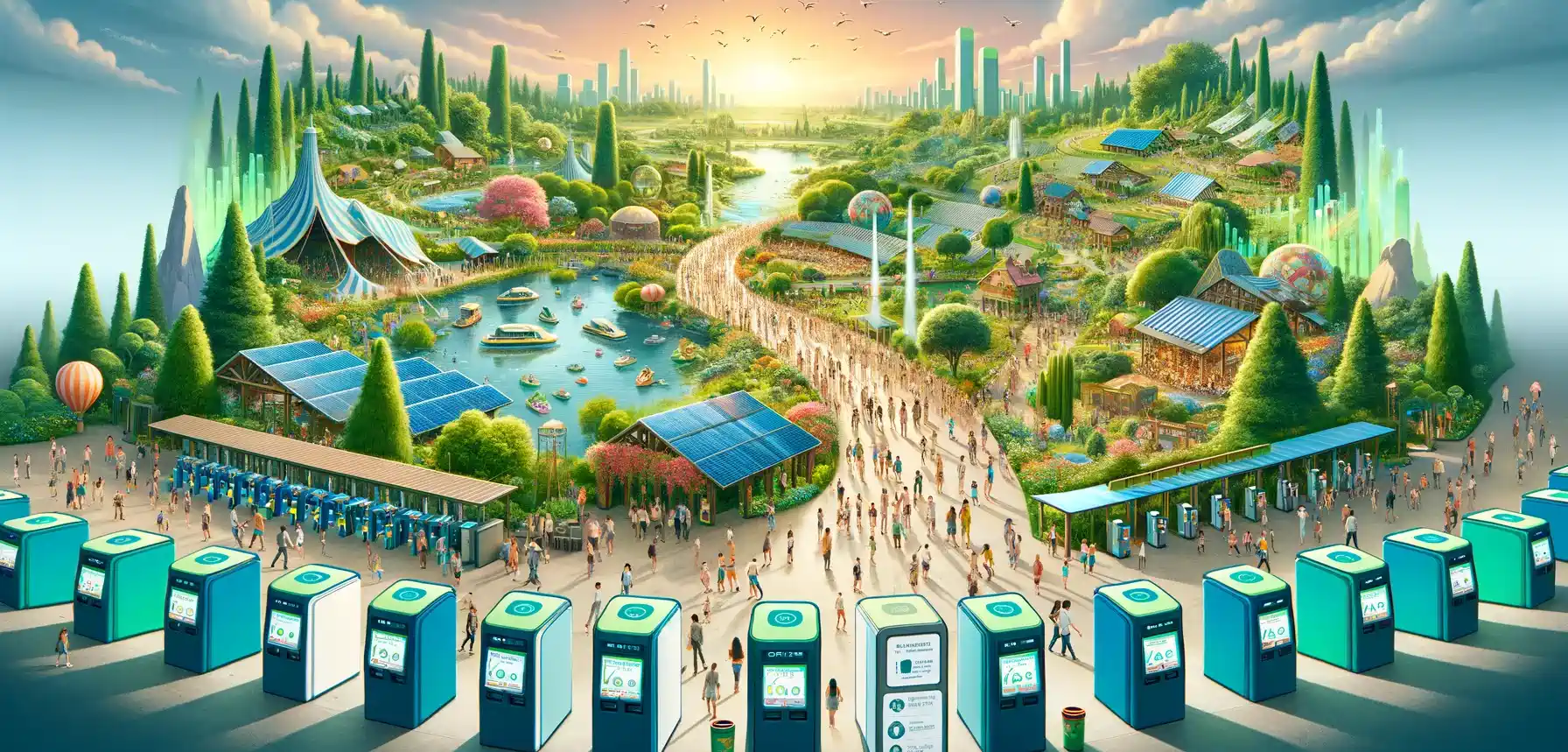
Eco-Friendly Ticketing System
How can attractions, amusement parks, museums and other businesses in the experience industry consider environmental factors when choosing a ticketing system? And what impact do digital tickets, annual passes, season passes and SaaS solutions have on resource consumption?
The term climate-friendly ticketing system is often used to describe digital ticketing solutions that can reduce the need for paper tickets and physical handling. However, it is important to distinguish between specific digital features and documented climate benefits. A ticketing system does not automatically become climate-friendly simply because its tickets are digital.
In this article, we explain how a digital ticketing system can support efforts to manage resource consumption, the benefits a SaaS ticketing system can offer, and the technical choices relevant to businesses in the experience industry. We also look at how Flex4B approaches digitalisation, integration and ongoing technical optimisation.
What Is a Climate-Friendly Ticketing System?
A climate-friendly ticketing system is not a clearly defined technical category. The term is often used to describe ticketing solutions where digitalisation and technical optimisation can limit certain types of resource consumption.
For example, digital tickets can allow guests to purchase, receive and present their tickets without printing them. This can reduce the need for paper, printers and physical ticket distribution.
However, this does not necessarily mean that a digital ticketing system has a lower overall climate impact than a particular alternative solution. Digital systems also use resources, including servers, networks, electricity and electronic equipment.
If a ticketing system is marketed as having a specific climate benefit, relevant documentation is required. It is therefore more accurate to highlight the individual features and technical measures that may affect resource consumption.
For those wishing to investigate the actual climate impact of a digital system, methods are available to measure it. For example, the Green Software Foundation has developed Software Carbon Intensity (SCI), which describes a method for calculating software's carbon footprint based on factors including energy consumption, electricity supply and hardware.
Digital Tickets Instead of Physical Tickets
One of the most visible opportunities offered by digital ticket sales is the ability to provide tickets that customers can present directly on their smartphones.
This means, among other things, that:
- Guests can purchase and receive tickets electronically.
- Tickets can be presented on a smartphone.
- Tickets can be validated by scanning.
- Printing a paper ticket is not necessarily required.
- Tickets can be managed digitally as part of access control.
Digital tickets can therefore reduce the need for paper tickets, but the actual savings depend on how the business previously handled tickets and how the digital solution is used.
Integrated Webshop and Ticketing System
Another relevant area is the integration between a company's website, webshop and ticketing system.
When ticket sales are integrated into the existing website, guests can often complete their purchases through a continuous process without having to navigate between different external solutions.
This can provide benefits such as:
- A more consistent purchasing experience.
- Fewer unnecessary steps in the purchasing process.
- A consistent visual identity.
- Simpler administration when several functions are combined.
- Better opportunities to optimise the overall user journey.
An integrated solution can also make it easier to identify unnecessary page loads and data transfers. However, fewer clicks do not automatically mean lower electricity consumption. This depends on factors such as code, hosting, data volumes and the specific structure of the systems.
Web Design with a Focus on Resource Consumption
The website and webshop associated with a ticketing system can also be optimised with a focus on speed, data transfer and efficient use of digital resources.
This may include image compression, responsive images, efficient JavaScript, caching and limiting unnecessary third-party scripts.
Read our article about sustainable web design and optimising website resource consumption, where we examine the technical possibilities and explain why an optimised website cannot automatically be described as climate-friendly.
Ongoing System Updates
A ticketing system requires ongoing maintenance to support new technologies, security, functionality and good performance.
With SaaS, Software as a Service, operations and updates are typically managed centrally by the provider. This can make it easier to implement technical improvements across customers' solutions.
New technologies and ongoing optimisations can, for example, improve loading times, data processing and usability.
However, a SaaS system is not automatically more energy-efficient or climate-friendly than other types of systems. The result depends on the specific software, server operations and usage.
Benefits of SaaS-Based Ticketing Systems
For attractions, experience centres, museums, zoos and amusement parks, a SaaS ticketing system can combine several digital functions in a single solution.
This can provide both administrative and practical benefits, regardless of any environmental effects.
- Digital tickets: Guests can receive and present tickets electronically instead of printing them.
- Digital access control: Tickets can be scanned and validated at the entrance.
- Efficient ticket sales: Sales and administration can be handled digitally.
- Improved user experience: A straightforward purchasing process can make it easier for guests to book tickets.
- Integration: Ticketing systems, webshops and other functions can work together.
- Digital annual and season passes: Passes can be offered electronically as an alternative to physical plastic cards.
- Flexible design: Websites and webshops can be adapted to the company's visual identity.
- Ongoing updates: New features and technical improvements can be implemented centrally.
A SaaS ticketing system can therefore support the digitalisation of various business processes. Whether it also provides an overall environmental benefit requires a specific assessment of the solutions being compared.
Digital Annual Passes and Season Passes as an Alternative to Plastic Cards
Many attractions offer annual passes, season passes, membership cards or VIP cards to their guests.
Traditionally, these passes may be issued as physical plastic cards. With a digital solution, guests can instead access their passes electronically, for example through a smartphone.
Digital passes can provide several practical options:
- The pass can be displayed on the guest's smartphone.
- The guest does not necessarily need a physical plastic card.
- Memberships and access rights can be managed electronically.
- Scanning and access control can be carried out digitally.
- The business can offer digital passes as an alternative to physical cards.
If digital passes replace physical cards, the need to produce and handle plastic cards can be reduced. However, the overall environmental effect depends on factors including card materials, production, lifespan and the digital solution's resource consumption.
Flex4B – A Digital Ticketing System Focused on Efficient Resource Use
Flex4B from Flex4Business ApS is a SaaS system designed for attractions and other businesses in the experience industry.
The system combines several functions for ticket sales, webshops, digital passes and administration, allowing businesses to manage different aspects of sales and access control within the same platform.
At Flex4Business, we continuously work on technical optimisation, speed, usability and efficient management of digital resources.
Digital Tickets and Access Control
Flex4B offers electronic tickets that guests can present directly on their smartphones.
Tickets can be scanned at the entrance, for example using compatible smartphones or existing devices used for access control.
This makes it possible to handle ticket sales and validation digitally without necessarily printing tickets.
Annual Passes, Season Passes and Membership Cards
Flex4B supports different types of passes, including annual passes, season passes and VIP passes.
Passes can be offered digitally, for example through electronic links and smartphone solutions, including iPhone and Android.
This allows businesses to offer guests digital passes as an alternative to physical cards.
Integrated Website, Webshop and Ticketing System
Flex4B makes it possible to combine a website with a CMS, webshop, ticketing system and pass management system in one integrated solution.
This can make it easier to create a seamless purchasing process and manage multiple functions through the same platform.
By combining these functions, businesses also have the opportunity to work on technical structure, loading performance and user experience across the solution.
However, a unified platform is not in itself evidence of lower energy consumption. This depends on the specific implementation and usage.
Ongoing Technical Optimisation
Flex4B is continuously developed and updated with a focus on areas including:
- Optimisation of code and system features.
- Speed and website performance.
- Support for modern image and web technologies.
- Technical SEO and mobile-friendly web design.
- Integration between different system functions.
- Usability for both guests and administrators.
These technical measures can help limit unnecessary data processing and transfer. However, they do not in themselves demonstrate that Flex4B is more climate-friendly overall than competing ticketing systems.
Flex4Business' Environmental and Energy Initiatives
In addition to our work with digital solutions, Flex4Business ApS has several specific environmental and energy initiatives in our daily operations.
Our efforts include:
- Hosting: We use a data centre that focuses on energy optimisation and efficient server operations.
- Printed materials: We limit the use of printed materials and use LaserTryk, a Nordic Swan Ecolabelled and FSC-certified printing company with documented environmental initiatives.
- Hardware: We provide guidance on hardware choices where electricity consumption can be one of the criteria, for example for ticket scanning.
- Waste: We sort waste according to applicable waste sorting schemes.
- Disposable products: We try to limit the use of disposable products.
- Digital communication: We work primarily digitally to reduce the need for paper and printing.
- Purchasing: We consider factors such as durability and opportunities for recycling.
- Remote work: We often work from home up to four days a week, reducing the need to travel to the office.
- Online meetings: We use digital meetings whenever practical to reduce travel needs.
These activities describe our working methods and specific initiatives. They do not mean that Flex4Business as a whole is carbon neutral or has a particular documented climate impact.
How Can a Ticketing System Be Optimised to Address Resource Consumption?
A digital ticketing system consists of several technical components, each of which can affect data volumes, speed and resource consumption.
For businesses wishing to address these areas, the following measures may be relevant.
Image Formats and Compression
Modern image formats such as WebP and AVIF can often reduce image file sizes compared with older formats while maintaining comparable visual quality.
By adjusting image dimensions and compression, unnecessary data transfer can be limited.
This can be relevant for product pages in the ticketing system, the webshop and the company's other website content.
Video Optimisation
Videos can be among the most data-intensive elements on a website.
It may therefore be relevant to examine video formats, compression, resolution and the need for autoplay.
Formats and codecs such as WebM, VP9, H.264 and AV1 can be considered depending on browser support and specific requirements.
Efficient Navigation and Fewer Unnecessary Steps
A clear webshop and a well-designed purchasing process make it easier for guests to find and buy tickets.
For example, it may be relevant to:
- Make ticket products easy to find.
- Limit unnecessary steps in the purchasing process.
- Avoid repeated page loads where they are not needed.
- Optimise product pages for smartphones.
- Use simple and understandable forms.
Good navigation can improve the user experience and limit unnecessary interactions. However, fewer clicks cannot automatically be translated into a specific energy saving.
Technical SEO and Website Performance
A ticketing system with a webshop can also benefit from technical SEO and good website performance.
Optimising images, code, caching and loading times can make pages faster and improve the user experience.
Google's Core Web Vitals measure aspects such as loading performance, responsiveness and visual stability.
Good technical performance is relevant to SEO, but does not in itself mean that a website has a documented environmental benefit.
Colour Choices, Dark Mode and Icons
Colours and Dark Mode can affect electricity consumption on certain screen types under specific conditions, particularly OLED displays.
However, this does not mean that dark colours generally make a website more climate-friendly. The effect depends on factors including screen technology, brightness and usage.
The same applies to icons. Choosing between SVG, icon libraries and other solutions should be based on design, functionality and the actual resources loaded by the browser.
Read more about these topics in our article about sustainable web design and technical optimisation.
How Do You Choose a Ticketing System with a Focus on Digitalisation and Resource Consumption?
When an attraction, amusement park or museum needs to choose a ticketing system, the decision should primarily be based on the business's requirements.
For example, it may be relevant to investigate:
- Whether the system supports digital tickets.
- Whether annual passes and season passes can be offered electronically.
- Whether scanning can be performed using existing compatible equipment.
- Whether the webshop and ticketing system can be integrated with the website.
- Whether the system is regularly updated and maintained.
- Whether the platform supports image optimisation and good website performance.
- Whether the hosting provider can document its energy and environmental initiatives.
- Whether unnecessary administrative processes can be limited.
If a provider markets a ticketing system as climate-friendly, sustainable or carbon neutral, the business should also investigate what documentation supports the claim.
A solution can offer many relevant digital and technical benefits without necessarily having a documented lower overall climate impact.
A Digital Ticketing System Can Support Multiple Goals
Digitalising ticket sales is not only about environmental and resource considerations.
For businesses in the experience industry, digital tickets, integrated webshops, electronic passes and scanning can also contribute to a more seamless guest experience and simpler administrative processes.
At Flex4Business, we work to combine these functions in the Flex4B system while maintaining an ongoing focus on technical optimisation and efficient use of digital resources.
If you would like to learn more about digital tickets, annual passes, season passes, webshops and access control, you can contact Flex4Business ApS for a no-obligation discussion.
Frequently Asked Questions About Climate-Friendly Ticketing Systems and Digital Tickets
What is a climate-friendly ticketing system?
The term climate-friendly ticketing system is often used to describe digital ticketing solutions that aim to limit factors such as paper consumption and unnecessary data transfer. However, a ticketing system is not automatically climate-friendly simply because it is digital. A specific claim of lower climate impact requires relevant documentation.
How can digital tickets reduce paper consumption?
Digital tickets can be purchased, received and presented electronically, for example on a smartphone. This means that printing physical tickets is not necessarily required. It can reduce paper consumption and the need for physical ticket handling, but the overall environmental effect depends on several factors.
What are the benefits of a SaaS-based ticketing system?
A SaaS-based ticketing system can offer digital ticket sales, electronic tickets, scanning, webshop integration and ongoing software updates. Depending on the solution, it may also support digital annual passes and season passes. However, SaaS alone does not demonstrate lower energy consumption or a reduced climate impact.
Can digital annual passes and season passes replace plastic cards?
Yes. A ticketing system with digital annual passes and season passes can allow guests to present their passes on a smartphone. This can reduce the need for physical plastic cards when digital passes are used as replacements. The overall environmental impact depends on factors including production, usage and digital operations.
How does Flex4B address resource consumption in its ticketing system?
Flex4B focuses on ongoing technical optimisation, digital tickets, electronic annual passes and season passes, and integration of websites, webshops and ticketing systems. We also work with image optimisation, website performance and efficient code. These features can limit certain types of resource consumption, but do not in themselves demonstrate an overall reduction in climate impact.
Does integrating a webshop and ticketing system reduce energy consumption?
Not necessarily. An integrated webshop and ticketing system can provide a more seamless purchasing process and opportunities to limit unnecessary steps and data transfers. However, the actual effect on energy consumption depends on the systems' architecture, hosting, code and usage patterns.
How can an attraction choose a ticketing system with environmental considerations in mind?
An attraction can investigate options such as digital tickets, electronic season passes, the use of existing scanning equipment, efficient website performance, integration and documented environmental initiatives from the hosting provider. If a supplier makes specific climate or environmental claims, relevant supporting documentation should be available.